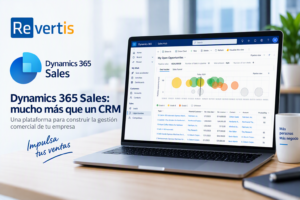
When people talk about Dynamics 365 Sales, they usually describe it as Microsoft’s CRM. That definition is correct, but it falls short.
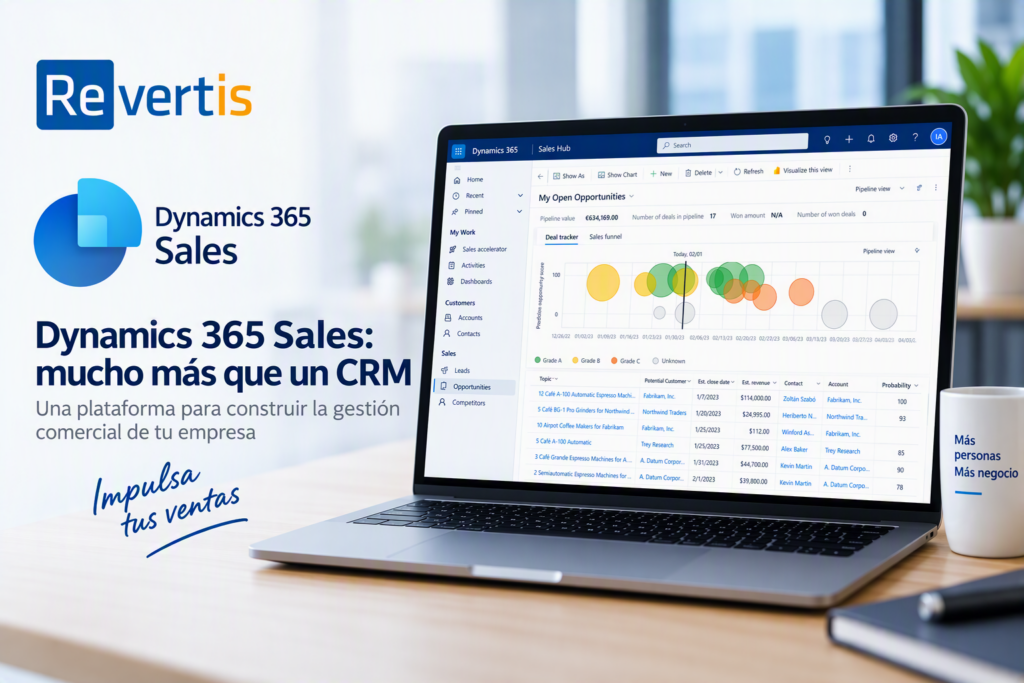
A traditional CRM lets us organise customers and contacts, record opportunities, follow up on sales activities and keep track of our pipeline. Dynamics 365 Sales does all of this, but its real potential goes much further.
The key is to understand that this is not just a CRM application. It is a solution built on Microsoft Dataverse, inside the Microsoft ecosystem and closely tied to Power Platform.
That significantly changes the way a CRM project is approached.
Is Dynamics 365 Sales a CRM? Yes, but not only that
Let’s start with the obvious.
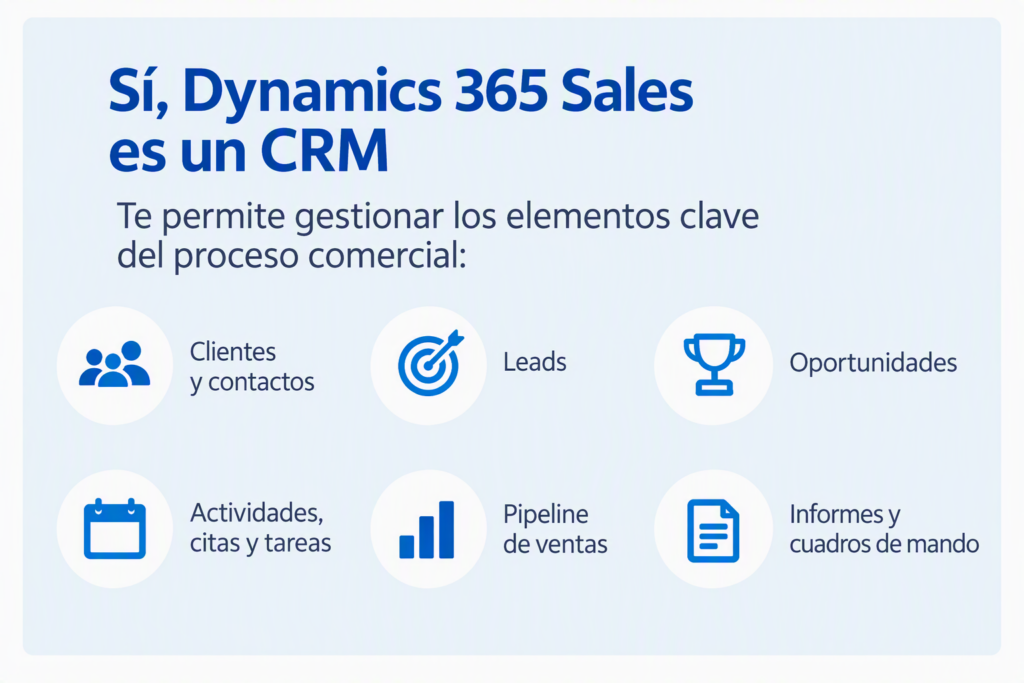
Dynamics 365 Sales lets you manage the usual elements of the sales process:
- Customers and contacts.
- Leads and prospects.
- Opportunities.
- Activities, appointments and tasks.
- Tracking of sales interactions.
- Sales pipeline.
- Sales processes.
- Reports and dashboards.
So, yes, Dynamics 365 Sales is a CRM.
But reducing Dynamics 365 Sales to these features means staying on the surface.
The difference lies underneath: Microsoft Dataverse
One of the most important things to understand about Dynamics 365 Sales is what sits behind the application.
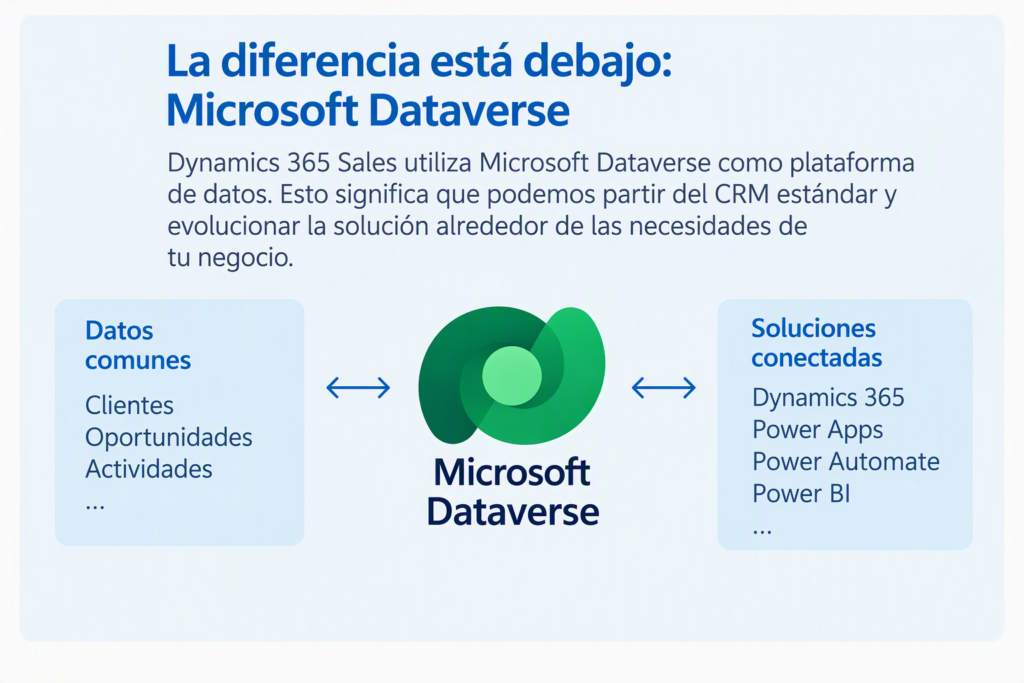
Dynamics 365 Sales uses Microsoft Dataverse as its data platform.
This opens up a very different perspective. In our own projects we approach Dataverse as a common foundation on which the CRM, automations, Power Apps and Power BI can work, so that different solutions use shared information and present different views of that data.
This means the standard Dynamics 365 Sales model can be the starting point, not necessarily the end point.
From standard CRM to your company’s sales application
Every company sells in a different way, and every team has different needs within the same organisation.
Even companies in the same sector can have completely different sales processes: different sales stages, contacts, approvals, documentation, KPIs or follow-up needs.
This is where we see one of the great advantages of Dynamics 365 Sales.
Instead of forcing the company to adapt all its processes to a closed application, we can start from the standard CRM and evolve the solution around its sales needs.
The goal is no longer simply to “implement a CRM”.
The goal becomes building a sales management platform adapted to the organisation.
The customer service team does not need to see data in the same way as the field sales rep. With D365 Sales it is very easy to create an app for each group of employees. All the apps work on the same database, Dataverse: the same information, presented according to each team’s needs.
Sales work does not end with a sale. In fact, you could say it starts with the first sale. You have to retain the customer, understand their needs, offer them new products, anticipate their consumption, and so on.
That is why Dynamics 365 Sales is more than a CRM: it lets you manage the customer at every stage of the business relationship.
A data model we can extend
Customers, contacts and opportunities are only part of the information a sales team can work with.
Depending on the business, you may need to manage additional information related to the sales process or even to the customer’s administrative process.
On Dataverse you can build applications and extend the data model to meet those needs.
And this is where an important difference appears compared with many traditional CRM projects:
We don’t just think about which features the CRM has. We think about which sales process the company needs to manage and how we can build it within the Microsoft ecosystem.
That change of approach is fundamental.
Dynamics 365 Sales and Power Platform
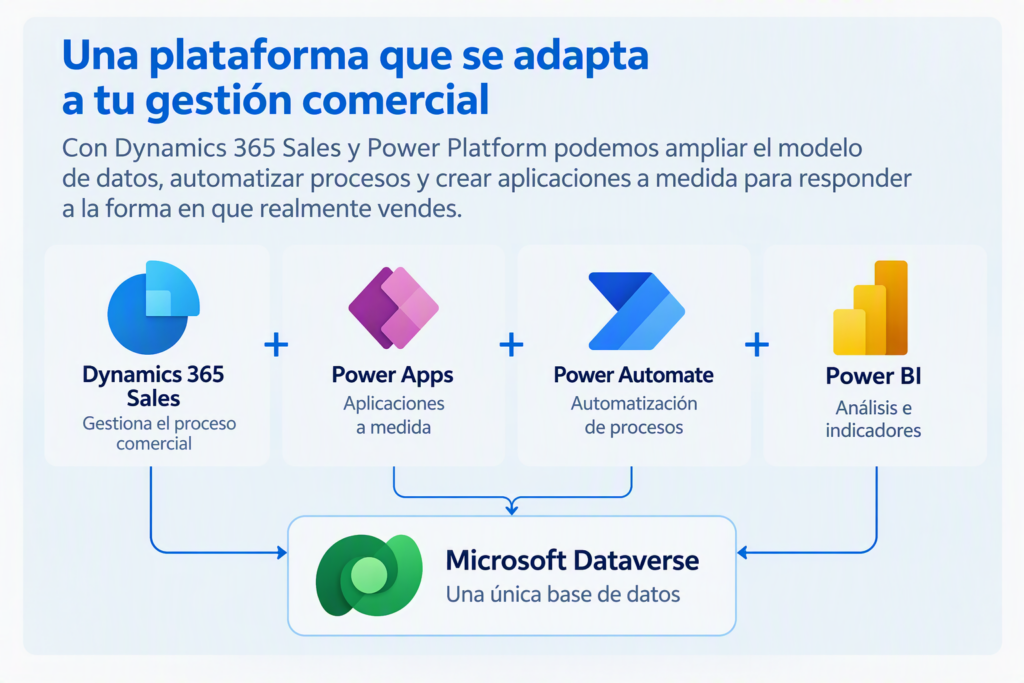
When we combine Dynamics 365 Sales, Dataverse and Power Platform, the possibilities grow considerably.
We can design an architecture in which:
Dynamics 365 Sales
manages the sales process.
Dataverse
centralises and structures the data.
Power Apps
extends the solution with apps tailored to specific processes.
Power Automate
automates processes and workflows.
Power BI
analyses the information and builds KPIs for sales management.
The result is an environment where the CRM is no longer isolated and becomes one piece of a much broader business platform.
Automating the sales process
Another important difference lies in automation.
Not everything should depend on a salesperson remembering what the next step is.
Dynamics 365 Sales lets you work with processes and automations to structure sales activity better.
This way, the CRM is not limited to storing what has happened.
It can play an active part in how we want our sales process to work.
Integrated into the Microsoft ecosystem
For many organisations, another differentiating factor is that Dynamics 365 Sales does not live in isolation.
It can work alongside the tools users already rely on every day within the Microsoft ecosystem.
This makes it possible to approach the CRM project not as “yet another application”, but as part of the company’s digital workplace, or as the hub for all customer activity.
Do you need a CRM or a sales platform?
That is why, when a company asks us which CRM we recommend, at Revertis we believe the question should go a little further:
Do we simply need a CRM, or do we need a platform on which to build our sales management?
Dynamics 365 Sales covers the usual needs of a modern CRM. But its real added value appears when we take advantage of Microsoft Dataverse, Power Platform and the rest of the Microsoft ecosystem to adapt the solution to each organisation.
The starting point can be very standard:
Customer → Contact → Lead → Opportunity → Activity → Sale
But the solution can evolve as the company’s processes and needs evolve.
The main strength of Dynamics 365 Sales
It is not just about implementing a tool for salespeople to enter information.
It is about designing an environment that supports the sales process, centralises information and can evolve with the business, including once the customer is already established.
CRM and ERP: what each one does
A CRM does not replace an ERP. Dynamics 365 Sales lets you create orders and invoices, but it does not include accounting or production. What it can do is retrieve information from the ERP, such as Business Central or Dynamics 365 Finance, so the sales team has it at hand.
Is Dynamics 365 Sales a CRM? Yes. But, backed by Dataverse and Power Platform, it can become much more: the platform on which to build a company’s sales management.
If you are considering a CRM or want to get more out of the one you already have, at Revertis we can help you with the implementation of Dynamics 365 Sales and the migration of your current CRM. Tell us about your project.